

Ανάρτηση Ερευνητικών Δοκιμίων no 11/26 & no 12/26

των Δημήτριου Κ. Χριστόπουλου και Ηλία Τζαβαλή
Περίληψη
Estimating production functions is challenging when firms’ input choices are jointly shaped by productivity and distortion shocks arising from credit constraints, taxes, subsidies, or regulatory wedges. In such environments, observed input variation reflects both technological productivity and distortion-driven adjustments, weakening the monotonicity and orthogonality conditions underlying standard proxy-variable and lag-based estimators. This paper develops a two-step estimator for production functions under distortions that identifies production elasticities using heteroskedasticity-based internal instruments. The approach does not require proxy inversion, external instruments, or restrictive one-to-one mappings between inputs and productivity. We establish identification, consistency, and asymptotic normality of the estimator. In the second step, the residual system is embedded in a linear state-space framework and estimated using Kalman filter–based Gaussian quasi-maximum likelihood to recover latent productivity and distortion processes. Monte Carlo evidence shows that the estimator delivers low-bias and low-RMSE elasticity estimates under distortion shocks, persistent measurement error, and feedback from distortions to productivity, while commonly used proxy-variable and lag-based estimators can become substantially biased. An application to manufacturing data yields plausible production elasticities and stable returns to scale. The estimated state-space system indicates that productivity is highly persistent, whereas distortions are more transitory and mean reverting, with statistically significant feedback effects on productivity.
O Δημήτριος Κ. Χριστόπουλος είναι Καθηγητής στο τμήμα Διεθνών και Ευρωπαϊκών Οικονομικών Σπουδών του Οικονομικού Πανεπιστημίου Αθηνών και ο Ηλίας Τζαβαλής είναι Καθηγητής στο τμήμα Οικονομικής Επιστήμης του Οικονομικού Πανεπιστημίου Αθηνών.
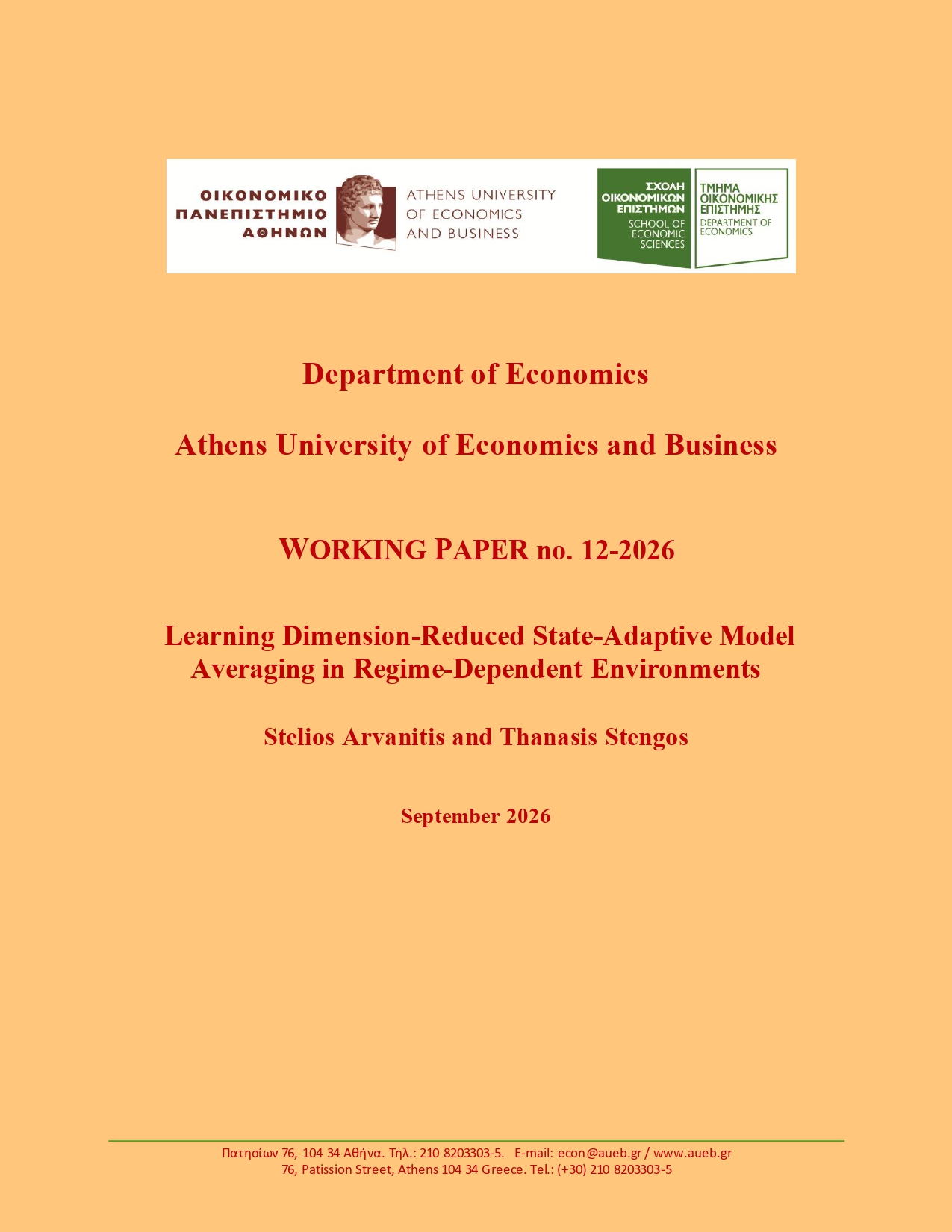
Ερευνητικό Δοκίμιο no 12/26 με τίτλο "Learning Dimension-Reduced State-Adaptive Model Averaging in Regime-Dependent Environments"
των Στέλιου Αρβανίτη και Θανάση Στέγγου
Περίληψη
We develop a statistical framework for learning low-dimensional state-adaptive predictive model averaging under model uncertainty. Rather than assigning fixed global weights to competing models, the method learns a simplex-valued allocation map that describes how their local predictive credibility changes across observable states. Sparse state learning discerns the coordinates organizing this geometry, and neural-network sieves approximate the resulting nonparametric allocation surface. We establish uniform concentration, sparse-oracle inequalities, set consistency for possibly nonidentified pseudo-true geometries, and finite-iteration guarantees for forward selection. In a cross-country growth data illustration, the method produces economically interpretable adaptive geometry while retaining competitive predictive performance; its out-of-period advantage over strong fixed-weight averaging is more modest. In a similar framework, Monte Carlo evidence shows that accurate adaptive prediction can coexist with uncertainty about the particular support or weight representation, consistent with a set-valued inferential target
Ο Στέλιος Αρβανίτης είναι Καθηγητής του τμήματος Οικονομικής Επιστήμης του Οικονομικού Πανεπιστημίου Αθηνών και ο Θανάσης Στέγγος είναι Καθηγητής του τμήματος Οικονομικών και Χρηματοοικονομικών του Πανεπιστημίου του Guelph.
 Πατησίων 76
 2108203 303